

Jeremy Sackett gave a zoom presentation to Bishopsteignton Probus Club about his career as a chemist at the Guinness brewery in London.
He worked there for 27 years, covering all areas of the large brewery and distillery.
His talk covered the factory’s production of distilled whiskey and gin, but focussed primarily on the brewing of beer which is a simple process that includes a lot of science combined with some important ways in which the brewers can create different varieties and flavours of beer by altering the contents and by changing how they process the beer at each stage of production; this is where the brewers’ ‘art’ and experience plays an important role in creating the best beers.
In essence, beer is made by heating grains of corn, usually barley, but oats and wheat can also be used. The resulting mix or ‘malt’ will vary in colour and flavour depending upon the content and how much it is heated; lightly-roasted malt produces a very pale beer whilst deeply roasted malts produce dark beers.




The malt is then put into hot, but not boiling, water for about an hour, which activates enzymes in the malt to break it down and release sugar from the malt grains, creating a sugary, sweet liquid called wort (pronounced ‘wurt’) which is transferred into a copper where hops are added for bitterness, and left to boil for another hour before more hops are added without further boiling to improve the aroma. The liquid is cooled to around 17 Degrees Celsius and transferred to a fermentation vessel, where yeast is added.
Here, the yeast eats the sugar, creating carbon dioxide and alcohol. More hops or different flavours can be added at this stage to create different types of beer. The length of fermentation alters the kind of beer being created, eg ales are heated for less time at cooler temperatures whereas lagers are kept colder for longer time.
After the fermentation process, alcoholic beer has been produced and can be put into casks, kegs, bottles or cans. Depending on the type of beer required, the treatment just before bottling or storage will vary. It could, for example, be filtered for clearer rather than cloudy beer or it could have carbon dioxide added to make it more fizzy.
In another part of his presentation, Jeremy said the brewing and distilling processes have become computerised so much that whereas it took 200 people to run the whole process when he joined the factory, the number had reduced to just two people by the time he retired.
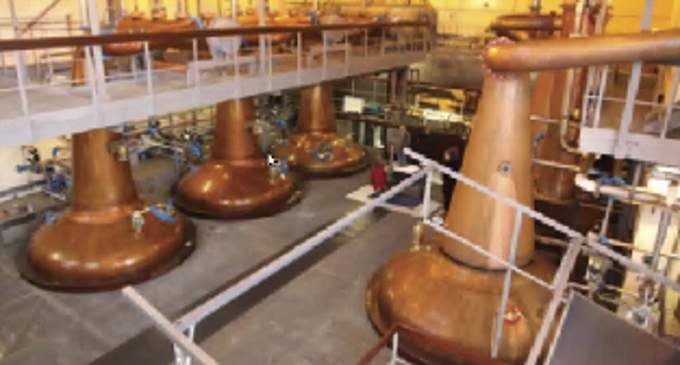
He also told the audience of the critical importance of maintaining the shape and size of the copper whiskey stills in order to maintain the whiskey flavour.