

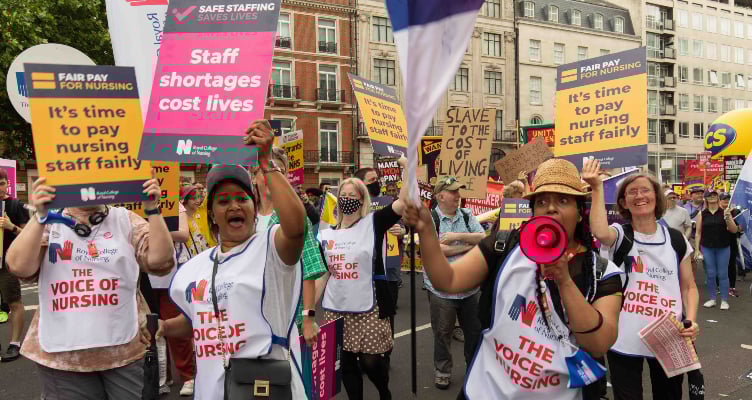
AS FIGURES show more than 500,000 people walked out during strikes in February, unions from across private and public sectors are planning further industrial action.
In the last month, nurses, doctors, ambulance staff, rail workers and civil servants have all taken to picket lines as the worsening 'winter of discontent' continues.
Now unions across nursing, ambulance and rail staff are proposing further strikes over the next few months.
Members of the UNITE union working for South Western Ambulance Service are due to strike again on Monday.




And GMB union members have planned strike days for March 6 and 20.
Their dispute over pay and staffing shortages has been ongoing for several months.
More than 10,000 GMB Ambulance workers will stage four more national strike days, the union announced today.
Paramedics, emergency care assistants, call handlers and other staff are set to walk out.
Rachel Harrison, GMB national secretary, said: ‘GMB’s ambulance workers are angry. In their own words ‘they are done’.
‘Our message to the Government is clear — talk pay now.’
Nursing union the Royal College of Nurses has announced it is to step up its ongoing dispute by staging a 48 hour walkout early in March.
The worsening dispute will see tens of thousands of nurses involved and this time, no serious service will be exempt, meaning the strike will now spread to staff working in emergency departments, intensive care and cancer care which had not previously been involved.
RCN bosses have accused the government of refusing to engage in negotiations.
The strike will run continuously for 48 hours from 6am on March 1.
A series of two-day strikes held by the RCN in December, January and earlier this month ran for 12 hours each time only during the day shift.
The RCN said it will reduce services to an ‘absolute minimum’ and ask hospitals to rely on members of other unions and other clinical professions instead.
Rail workers have announced another fresh wave of strikes in March and April.
Members of the RMT union from 14 train operators, including Great Western Railway, will walk out in the long-running dispute over pay, jobs and conditions.
The union, which represents 40,000 workers across Network Rail and the 14 operators, rejected offers from employers last week as they did not meet the ‘needs of members on pay, job security or working conditions’.
Strikes dates are March 16, 18 and 30 and April 1.
Members at Network Rail, responsible for tracks and bridges, will strike on 16 March and then ban overtime.
A spokesman for bosses the Rail Delivery Group said the strikes are ‘totally unjustified and will be an inconvenience to our customers, and cost people more money at a time they can least afford it’.
RMT general secretary Mick Lynch said: ‘Rail employers are not being given a fresh mandate by the government to offer our members a new deal on pay, conditions and job security.’
The RMT has said it wants an unconditional pay offer, but rail industry representatives have said any pay offer would have to come with changes to working conditions to fund any rises in pay.
The Communication Workers Union has also announced further strike action is being planned.
The union warned of more walkouts in its dispute over pay and more than 95 per cent of those who took part in the latest ballot voted for strikes.
The CWU has not yet set dates for fresh strikes but the vote gives it a six-month mandate for action running until mid-August.
Postal workers last walked out in December.
CWU general secretary Dave Ward said: ‘(The ballot result) is proof that for Royal Mail to begin functioning normally again, there needs to be a change in negotiating approach from its leadership that recognises the depth of feeling from the workforce.’
Members of the Public Services Unions have also been taking action affecting sectors including civil servants from the Border Force, Department for Work and Pensions, DVLA as well as physiotherapists and driving examiners.
Comments
This article has no comments yet. Be the first to leave a comment.