
THE PEOPLE of Devon are being urged to have their say on the biggest shake up in local government in 50 years.
The government has launched a consultation on five proposals which have been submitted in response to its call for clearer, more streamlined structures to replace Devon’s current two tier system with a new set of unitary councils.
The public have until midnight on March 26 to put their views forward on which proposal they think will deliver the best services for them.
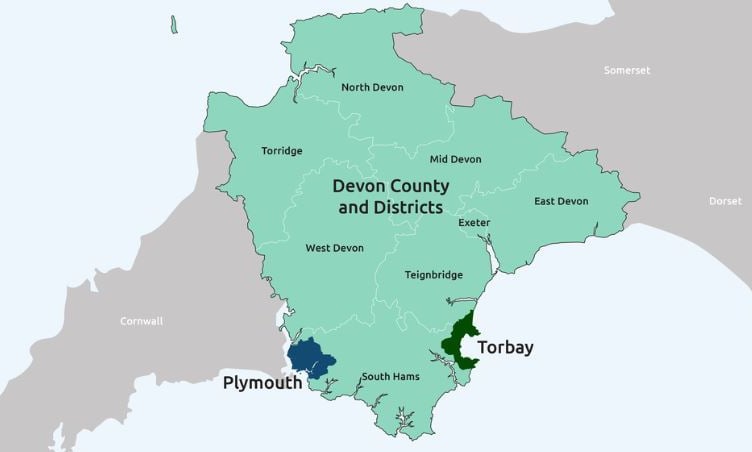
Local government reorganisation in Devon will see the eight district councils and the county council, who have different responsibilities, abolished in 2028.


From then on much larger and fewer unitary councils will be in charge of all local services from waste to social care and local road maintenance.
Devon’s councils put forward their preferred options in November after embarking on their own engagements with residents.
The proposals are:
Devon County Council wants to see a new Devon unitary council serving a population of 842,000 operating alongside the existing unitary authorities of Plymouth City Council and Torbay Council.
The district councils’ vision known as the 4-5-1 model is a three unitary council made up of Exeter and Northern Devon (covering east East Devon, Exeter, Mid Devon, North Devon and Torridge.), Torbay and Southern Devon (covering the South Hams, Teignbridge, Torbay and West Devon) and Plymouth (on its existing footprint).
There is also a modified version of this which includes an expansion of Plymouth into the parishes of Bickleigh, Shaugh Prior, Sparkwell and Brixton and limited to those areas within the Plymouth Policy Area as defined within the Joint Local Plan).
Plymouth City and Exeter councils are proposing a four unitary model of an expanded Plymouth (taking in 13 parishes of the South Hams) an expanded Exeter (taking in 49 surrounding parishes from Teignbridge, East Devon and Mid Devon), an expanded Torbay (taking in 21 nearby parishes) and a new Devon coast and countryside council.
Finally Torbay supports a four unitary model and wants to continue as a unitary council on its existing boundaries, an expanded Plymouth City Council covering the Plymouth growth area, a new Exeter council reflecting the functional housing and labour market around the city and a new rural Devon coast and countryside council covering the remainder of Devon.
Devon is one of 14 areas with different tiers of local government which are being restructured.
The government says the proposals show plans to “simplify the needless duplication and reduce bureaucracy”.
“This is the latest step in our plans to reorganise local government which will end the current wasteful two-tier system and replace it with stronger unitary councils that can deliver for local people,” it said.
“Residents will receive better, more efficient public service, freeing up cash for local priorities like fixing potholes and more regular bus services as a result.”
Minister of state for local government and homelessness, Alison McGovern said: “Unitary councils provide clarity for residents and are more effective. That’s why we’re carrying out the biggest change to local government in a generation, and I would encourage local people and businesses to share their views in shaping the future of their area.”
Some councillors in Devon have been critical of the reorganisation and say a depletion in councillor numbers will reduce democracy.
There has also been anger over local taxpayers having to pick up the bill for the cost of consultants and transitioning to new councils and not the government.
The secretary of state will make a final decision on which proposal is carried forward later this year. New shadow authorities will come into play in 2027 and go live on April 1, 2028.
Comments
This article has no comments yet. Be the first to leave a comment.