

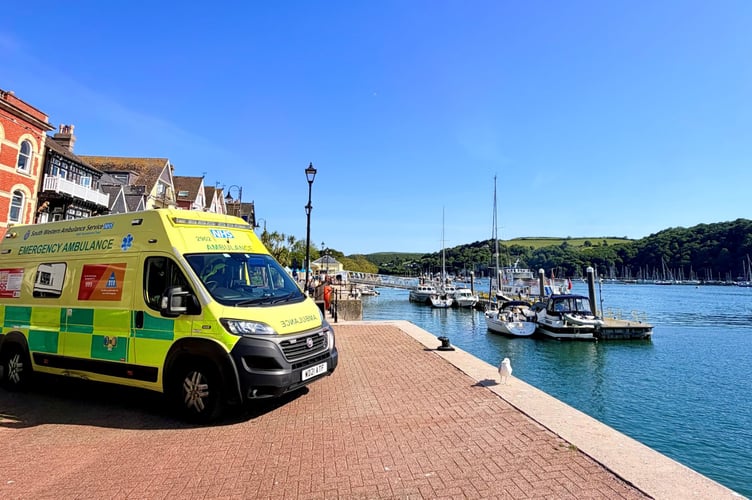
AMBULANCE chiefs in the south west reported the busiest day on record yesterday.
But they have issued an urgent appeal to use the services appropriately having received calls about issues including sunburn and feeling hot.
South Western Ambulance Service NHS Foundation Trust said crews responded to almost 4,000 incidents across the region.
But the service is appealing to residents and visitors to protect themselves during the hot weather and use NHS services appropriately as sustained high temperatures continue to place ‘exceptional pressue’ on the ambulance service.

Demand has remained exceptionally high throughout the Bank Holiday period.
Between Friday and Tuesday, the trust responded to 18,206 incidents, compared with 14,684 during the equivalent period last year – an increase of more than 24per cent.
The ambulance service is reminding the public to choose the right healthcare service for their needs and only call 999 in a life-threatening emergency.
Where appropriate, people are encouraged to consider alternatives such as NHS 111, pharmacies, GP services, and urgent treatment centres.
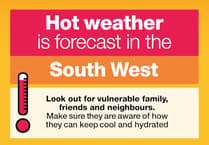
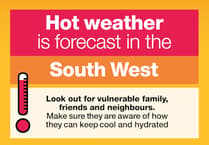
Members of the public are also being urged to take simple precautions to stay safe during the hot weather, including: drinking plenty of water, wear sunscreen and protective clothing, stay in the shade between 11am and 3pm and avoid strenuous activity during peak temperatures.
John Martin, Chief Executive of SWASFT, said: ‘We want to be there for everyone that needs us in a life-threatening emergency; to do this, we need to have our ambulances free to respond to those most in need.
‘If you call us and we’re not the right service for you, we will direct you to another part of the NHS, please do listen to this advice, as it could mean that you get the help you need more quickly.
‘We are receiving calls for issues such as sunburn, feeling hot, and other non-emergency conditions that can often be managed through self-care, pharmacies, NHS 111 or other healthcare services.
'Every less urgent 999 call reduces our ability to respond quickly to patients facing life-threatening emergencies.
'999 should be used for serious medical emergencies such as cardiac arrest, chest pain, breathing difficulties, suspected stroke, loss of consciousness, choking, severe allergic reactions or catastrophic bleeding.’
He added: ‘Our teams are working incredibly hard alongside NHS partners to manage these unprecedented levels of demand, and we are sorry when we cannot reach some patients as quickly as we would like.
'Please do not call back to ask for an ambulance arrival time. We are unable to provide estimated arrival times and repeat calls can delay our response to other patients needing urgent help.
‘I would like to thank our staff and NHS partners across the region for their continued dedication in delivering the best possible care under extremely challenging circumstances.’
The trust says it will continue to monitor demand closely and work with NHS partners across the region to provide the best possible care for patients throughout the period of extreme weather.
Comments
We've recently changed our login process. If you have an account for commenting, you will need to re-register on the login window.
This article has no comments yet. Be the first to leave a comment.