
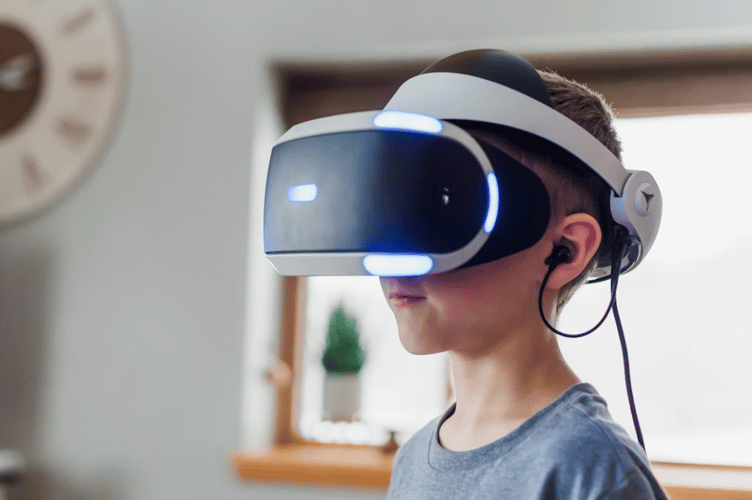
ENGAGING in virtual reality (VR) games may enhance motor performance for young people with dyspraxia, according to new research by a Devon university.
The preliminary study, conducted by researchers from the University of Exeter and published in JMIR, found that a home-based immersive VR game, Beatsaber, improved motor coordination in young people with dyspraxia, also known as Developmental Coordination Disorder (DCD).
Dr Gavin Buckingham, cognitive psychologist in the Department of Public Health and Sports Science at the University of Exeter, and project supervisor, said: ‘These findings provide some promising early evidence that Virtual Reality games like Beatsaber might be an effective way to improve motor control in children and adolescents with dyspraxia.
‘The next step would be to investigate whether virtual reality can help children enjoy a broader range of sporting activities at a young age’.



During the study, conducted by Mohammed Alharbi, 27 participants aged ten to sixteen played Beatsaber, which requires repetitive, goal-directed movements to build coordination and speed.
Children who played Beatsaber for 30 minutes a day for the entire week showed improvements in upper-body dexterity, compared to when they played games on a tablet.
Dyspraxia is a neurodevelopmental condition that affects the movement and coordination of 2 children in each class of 30 in the UK.
Individuals often struggle with object manipulation, such as grasping, kicking, or throwing, and locomotor skills including walking, running, and jumping.
These difficulties can impact everyday activities such as play, as well as school-based tasks like writing, colouring and using scissors, potentially affecting confidence, participation and quality of life.
One participant was Frankie, a sixteen-year-old from Devon, who was diagnosed with dyspraxia at the age of eight. Frankie receives dyspraxia support from his school, allowing him to use a laptop instead of handwriting his work.
Frankie said: ‘I remember when I was in high school, I used to hate the lunch queues because I would keep bumping into people, it was just the worst.
‘I am prone to dropping things and I tend to leave my laces done up as tying them can be difficult, but I’ve lived with dyspraxia for so long that this feels normal to me.
‘The games were really fun and I noticed I got quicker with the hand dexterity tasks, but my balance and hand-eye coordination also improved after using the VR.
‘Dyspraxia isn’t something you really see people talking about, so I hope that research like this can change that’.
The paper is published in JMIR and entitled ‘Home-Based Immersive Virtual Reality to Improve Motor Performance in Children and Adolescents With Developmental Coordination Disorder: A Crossover Study’.
Comments
This article has no comments yet. Be the first to leave a comment.