

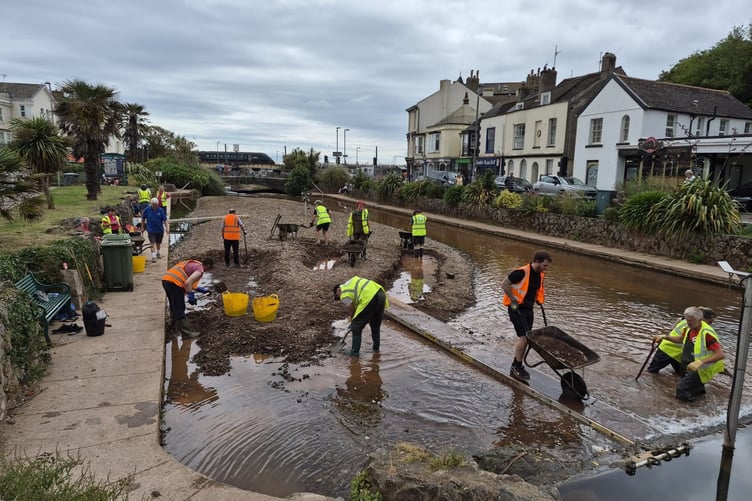
TWO days of this summer’s efforts to clear the Brook in Dawlish saw volunteers removing some of the built-up sediment in the waterway.
Legally, the team from WADE Waterways Around the Dawlish Environment have only just been allowed to get into the water to begin the task.
Now, for the second year, WADE volunteers have been given a permit by the Environment Agency to carry out the work, although it must be done by hand and at certain times of the year.
The group, joined by volunteers from Dawlish Celebrates Carnival and Dawlish Sparkles, have been digging out and weeding the largest island to help the water flow freely by removing the accumulated silt.


Local businesses have supplied the volunteers with drink and ice creams.
A second ‘big dig day’ is planned for Tuesday June 30.
A spokesman for WADE said: ‘This work on the Boating Lake will help maintain and equalise water depth and habitat quality, help fish movement through low-flow periods, and benefit juvenile fish and other aquatic wildlife while keeping the channel functioning as intended.
‘It will also provide a wide body of water we hope will help provide a cooler space for Dawlish in hot weather.
‘Since 2024, WADE volunteers have been permitted to carefully redistribute some of this material by hand.
‘This is not dredging and has far less impact on the Brook’s wildlife and ecology.’
The volunteer effort follows repeated calls for the Brook to be dredged.
However, the land is owned by Teignbridge District Council and it is considered dredging is neither a sustainable or environmentally appropriate solution.
Town councillor Scott Williams and the WADE team are hoping to move much of the sediment build up nearer the sea so it can be naturally washed away.
They are restricted to tight permit arrangements by the EA and any variation could be punishable by large fines or even imprisonment.
The work has to be done by hand because no mechanic equipment such as diggers is allowed in the Brook.
The Brook contains around 20 weirs and sluices. After storms, gravel and silt naturally move downstream towards the sea.
The spokesman said: ‘We have successfully applied for additional permits to carry out similar work in other bays - and also seeking to improve the safety of nesting sites for the swans.
‘Nature will ultimately shape the Brook, and solutions must work with those natural processes.
'Studies showed that, because of the many weirs along the Brook, dredging would have only a limited effect on water levels during flood events, particularly when the catchment is already saturated.’
Over the last year, WADE volunteers have focused on maintenance, litter clearance and weir management which has helped develop a long-term maintenance strategy.
The aim is to strengthen banks, create attractive habitats, provide safer swan nesting areas above flood levels and support biodiversity, while ensuring floodwater can still move freely through the channel.
The spokesman added: ‘With time, the Brook could once again become a jewel of the town.
‘A thriving Brook would stand as an example of a community working together with nature rather than against it.’
Comments
This article has no comments yet. Be the first to leave a comment.