

CLEAR-sighted students at a Newton Abbot primary school have learned there is more than meets the eye to the world of vision.
The eager pupils at Bradley Barton Primary School were being given a special Science, Technology, Engineering and Mathematics (STEM) presentation by guest speaker and professional optometrist Winnie Maina.
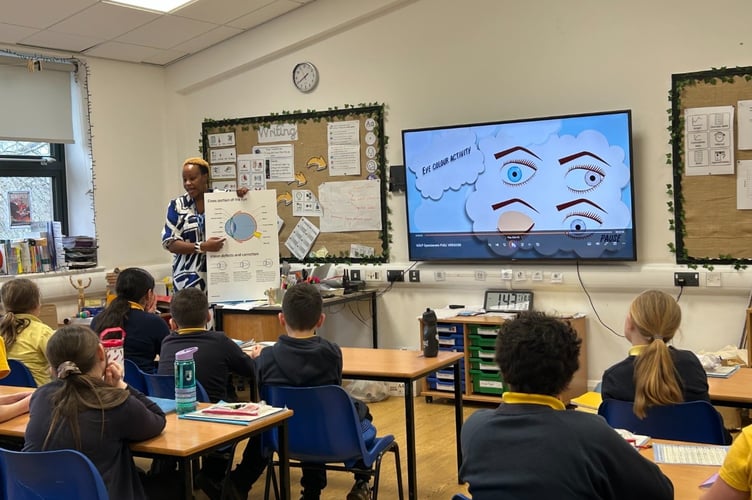
Winnie, a director at the locally owned and run Specsavers stores in Paignton and Totnes, had been invited to the school to share valuable insights into the many complexities of the human eye.




She told the Year 6 pupils how the eye works, why eye colour varies between people, and how staring at the sun damages the eye.
Winnie said: ‘When explaining how the eye works, I told the students how information is transported to the brain via the optic nerve to give people their sight.
‘To bring this to life, I used the analogy of the eye as a camera, the optic nerve as an HDMI cable, and the brain as a computer processing the information, which all the pupils understood.
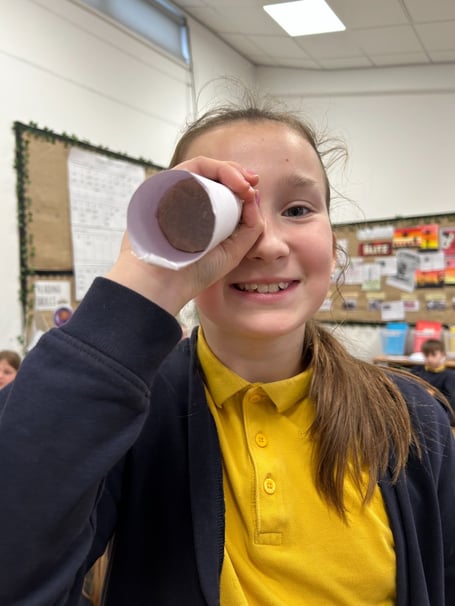
‘We then did a practical exercise, building a pinhole camera from used toilet roll centres, parchment paper, foil and a piece of white card.
‘This gave the pupils a simple, lensless camera that produced a real, inverted and diminished image, demonstrating that light travels in a straight line.
‘The pupils really seemed to enjoy the lesson, and I think they were very pleased with the goody bags I handed out.’
Winnie’s STEM talk was in support of British Science Week, a 10-day celebration encouraging students to enjoy hands-on activities, community events and school workshops.
Teacher Lauren Miller saidI: ‘We’re so grateful to Winnie for visiting us during Science Week. It really helped to raise the profile of STEM across the school and we learnt so much.
‘Her talk about the eye and her journey to become an optometrist was fascinating and helped the children understand how studying science can introduce them to diverse careers.’
Comments
We've recently changed our login process. If you have an account for commenting, you will need to re-register on the login window.
This article has no comments yet. Be the first to leave a comment.