
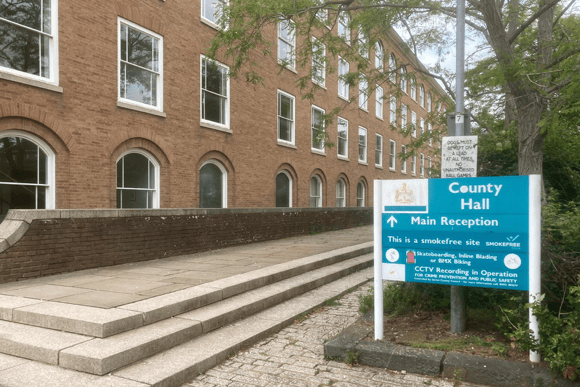
DEVON’S leader Julian Brazil has criticised the financial settlement that has just landed on County Hall’s doorstep, claiming government funding has been cut for the county.
Councils across England are being told today how much money they will get from the government to help them pay for services.
The government has announced a three-year settlement, something councils including Devon have been calling for.
This means councils will know how much money they will have in each of the next three years rather than waiting until December to find out what their fate is for the next 12 months.




But Cllr Brazil (Liberal Democrat, Kingsbridge) has criticised the county’s payout, suggesting that Westminster is implying it is being more financially generous even though hikes in council tax will actually be required for the council to secure more cash.
Cllr Brazil said while the county would get £1.7 million extra from government in the next financial year, it would then see two years of losing £5.8 million.
The government has said ‘core funding’ has risen, but that includes council tax, and effectively means Devon will have to increase its council tax by the maximum allowable to see its income rise.
Alternatively, it could put pressure on the administration to oversee cost-savings and cuts.
“They are implying they have given us extra money but they haven’t,” said Cllr Brazil.
“It means services are now being paid for by local taxpayers and not central government. By saying core funding has risen gives the impression that we have got loads of money and should splash it around, but we don’t.”
Councillor James Buczkowski, the Council’s Cabinet Member responsible for finance, said: “There is a great deal of confusion being created by the way these figures are being presented. Claims of a ‘23 per cent increase’ in funding for Devon are simply not accurate and risk misleading residents.
“That figure is a cumulative core spending power measure over several years. It is not a year-on-year increase, and it is not new money being provided by government to the county council.”
“Core spending power is not the same as government funding.”
Cllr Buczkowski (Liberal Democrat, Cullompton) added the year-on-yuear increase shown in core spending power is about 5 per cent, but that is “driven largely by these council tax assumptions rather than by any significant uplift in core government grant”.
“What we are seeing again is the burden of funding essential local services being moved away from central government and on to local residents.
“Presenting assumed council tax rises as if they were government funding is not transparent.
“It effectively forces councils to increase council tax just to stand still, while allowing ministers to claim funding increases that are not being delivered through grant.”
The government states on its website that the settlement is the first multi-year settlement “in a decade” and that there would be a consultation setting out its “provisional allocations” for all three years of the multi-year settlement.
“We will consult as required on the Settlement in 2026-27 and in each subsequent year,” the Treasury’s website states.
“Final allocations for 2027-28 and 2028-29 will be confirmed in their respective years.”
This consultation will last for four weeks from 17 December 2025 to 14 January 2026.
It also states that where local government reorganisation takes place, it “will be for areas to agree how to divide the funding where the establishment of new unitary authorities means existing local authorities are split”.
“We will provide guidance to local authorities on how to arrive at local agreements, and will set out a timeline for when these agreements must be reached,” the government said.
“We recognise the competing pressures of local areas needing to agree the funding split as soon as possible ahead of vesting day for the new authorities, as well as the need for government to review the agreement and incorporate it through the usual Settlement process.”
It added where agreement couldn’t be reached, the Ministry for Housing, Communities and Local Government would “make a determination”.
In terms of how funding councils will change, the government outlines a desire to move from ‘legacy funding’ to a ‘fair funding’ method over the next three years, through changes to business rates.
And in terms of the revenue support grant (RSG) portion of funding, an important part, the government wants a third of next year’s RSG funding via the latter model, two-thirds the year after, and then full fair funding in 2028/29.
Last year, Devon was told it had lost the rural services delivery grant, worth around £10 million to the county.
However, in 2024 it secured a £95 million grant from the Department for Education to support its special educational needs and disabilities service, albeit the cash is paid over nine years and requires contributions and savings from the county council.
Comments
This article has no comments yet. Be the first to leave a comment.