
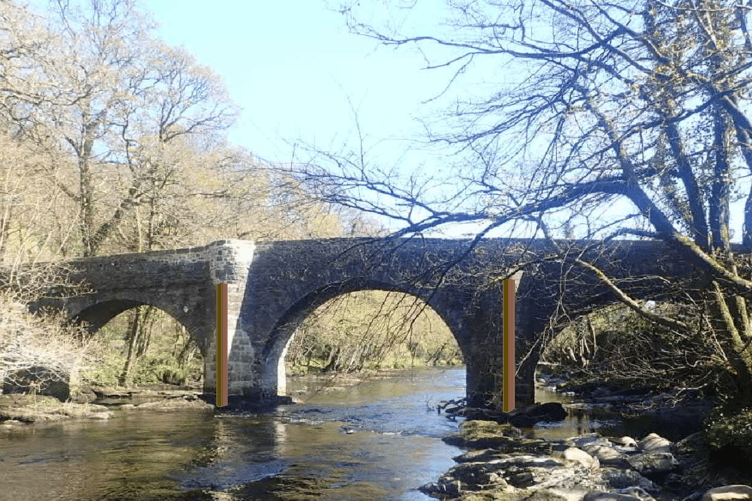
PLANS to protect a historic bridge near Buckfastleigh from damage caused by trees and debris carried down the River Dart have been approved.
Teignbridge Council has granted Listed Building Consent for Devon County Council to install steel protection plates, known as nosings, on the upstream cutwaters of the four piers of Grade II listed Austins Bridge, pictured.
The 17th-century bridge has undergone repairs on several occasions, but in recent years has suffered increasing damage during periods of high river flow.
Trees and other debris can become lodged against the upstream cutwaters, rubbing against the stonework and causing the loss of stone and mortar.
The problem was particularly severe during Storm Dennis in 2020, when a large tree caused significant damage to two of the cutwaters.
Parts of the structures were left suspended, requiring extensive and costly repairs.
According to the council, removing trees and debris from the bridge, carrying out emergency repairs and completing subsequent permanent repairs is a significant undertaking.
It can also require the road across the bridge to be closed, causing additional expense and disruption for local residents.
The approved scheme will see steel plates fitted to all four upstream cutwaters, providing additional protection against future impacts, while retaining the original bridge structure.
Devon County Council says the need for greater protection has become more pressing because of the increasing frequency of storms, a lack of maintenance along parts of the riverbank and the impact of ash dieback, which is expected to result in more dead and fallen trees entering watercourses.


The council said local opinion had strongly supported measures to prevent the type of extensive damage experienced in recent years.
The proposed nosings will be most visible from the river upstream of the bridge, looking downstream, and are expected to be largely hidden by the water.
At lower water levels, they will appear as a narrow strip on the points of the cutwaters.
The steel plates will be left unpainted so they can naturally patinate over time, with the intention of minimising their visual impact on the listed structure.
Devon County Council’s engineers and conservation advisers concluded that the conservation benefits of the work outweighed what they described as limited aesthetic impacts.
Comments
We've recently changed our login process. If you have an account for commenting, you will need to re-register on the login window.
This article has no comments yet. Be the first to leave a comment.